Garage Ink: The Obsessives Spending Thousands to Print Wedding Invitations One Letter at a Time
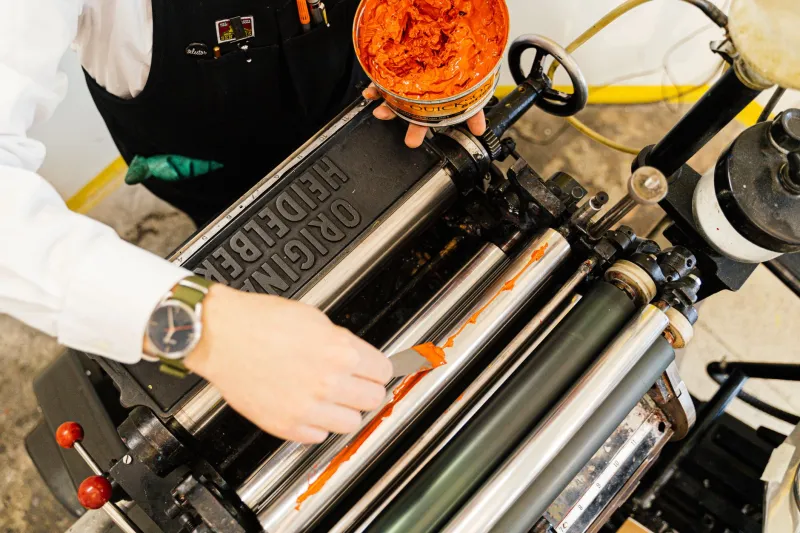
Let's set the scene. It's a Saturday afternoon in suburban Columbus, Ohio. Mara Chen, 34, is standing in her converted two-car garage — which no longer fits any cars — pressing her palm against a cast-iron machine the size of a small refrigerator. The machine weighs somewhere north of 800 pounds. It does not care about her timeline. It does not care that she's been troubleshooting the same ink distribution problem for three hours. It is a 1962 Chandler & Price platen press, and it has been doing this exact job since before Mara was born.
"I bought it off a retired printer in Indiana," she says, wiping a smear of oil-based ink off her forearm with the practiced indifference of someone who has long since accepted that her clothes are ruined. "He cried when I loaded it onto the truck. I almost cried too, and I didn't even know how to use it yet."
She does now. Mara is one of thousands of Americans who've tumbled headfirst into the world of DIY letterpress printing — a hobby that sits somewhere between fine craft, mechanical obsession, and a very expensive form of therapy. And a surprising number of them got there through wedding invitations.
The Rabbit Hole Starts With 'Save the Date'
For the uninitiated: letterpress printing is an ancient technique where type or imagery is set in relief, inked, and pressed directly into paper, leaving that distinctive tactile indent you can feel with your fingertip. It was the dominant printing technology for centuries before offset printing made it obsolete in the mid-20th century. Most of the equipment ended up in scrap yards, antique shops, or the garages of people exactly like Mara.
The modern DIY letterpress revival didn't start with weddings, but weddings gave it rocket fuel. Sometime in the early 2010s, handmade stationery started showing up on Pinterest boards and, eventually, Instagram feeds. The look — thick cotton paper, deep impression, a slightly imperfect charm that no laser printer could replicate — became aspirational. Wedding blogs went wild for it. And a subset of crafty, detail-obsessed people looked at the $800-per-hundred price tag from professional letterpress studios and thought: what if I just... learned to do this myself?
Reader, the math did not work out in their favor. At least not financially.
"I thought I'd save money," laughs Derek Vasquez, a 31-year-old graphic designer in Austin who now owns two presses and a modest collection of vintage wood type. "I spent about $4,000 on equipment and supplies to print invitations for my own wedding. A professional would have charged maybe $600. So I saved negative $3,400 and gained a hobby I'll probably have for the rest of my life."
The Learning Curve Is a Cliff
There's a reason letterpress printing was historically a skilled trade requiring years of apprenticeship. The variables are staggering. Ink viscosity changes with temperature. Impression depth — how hard the type bites into the paper — requires obsessive fine-tuning. Registration, the alignment of multiple passes through the press, can drift by a fraction of a millimeter and ruin an entire run. Paper moisture content matters. The age and condition of your rollers matters. Whether Mercury is in retrograde feels like it probably matters.
"My first real print run was a disaster," says Keisha Odoms, a 29-year-old librarian in Atlanta who learned letterpress through a local community print shop before eventually buying her own tabletop Adana press. "Uneven inking, one edge of the impression deeper than the other, a smear on the third card I couldn't figure out for two weeks. It turned out my roller height was off by literally a hair's width."
This is the part that hooks people. The troubleshooting. The mechanical puzzle-solving. In an era of infinite digital undo buttons, there's something almost transgressive about a process where mistakes are permanent and every variable has to be physically, manually corrected. Practitioners describe a specific kind of focus that descends when they're at the press — a narrowing of attention that, more than one person compared, unprompted, to meditation.
"I'm a software engineer," says Mara. "All day I'm working on things that are invisible, abstract, infinitely editable. When I'm at the press, the feedback is immediate and physical. Either the ink is on the paper or it isn't. I find that incredibly calming, actually."
Instagram Turned Ink Into Clout
It would be dishonest to ignore the social media dimension here. Letterpress work photographs beautifully — the texture, the depth of impression, the richly saturated ink on thick cotton stock. Accounts dedicated to handmade stationery have racked up hundreds of thousands of followers. The hashtag community is enthusiastic and surprisingly supportive for a corner of the internet.
But Instagram also created a certain pressure. What started as a personal craft project for many practitioners has, for some, drifted toward a semi-professional identity. Etsy shops open. Custom orders start trickling in. Suddenly you're a small business operator with deadlines and client expectations, which is a different animal entirely from printing invitations for your own wedding at your own pace.
"I had to make a real decision about whether I wanted this to be a business or stay a hobby," says Derek. "I chose hobby. I turn down paid work now. The moment it becomes a job, I think I lose the thing I love about it."
Not everyone makes that choice. A small but visible segment of the DIY letterpress community has built legitimate cottage businesses, printing bespoke stationery for clients who specifically want the handmade, one-person-in-a-garage origin story as part of the product. The authenticity is the point. The slight imperfections are the point. The fact that someone's hands touched every single card is, for a certain kind of buyer, worth a significant premium.
A Community of Ink-Stained Weirdos (Affectionate)
One of the more charming aspects of the letterpress revival is how aggressively communal it is. Online forums, regional print fairs, Instagram comment sections — people share equipment recommendations, troubleshooting tips, and warnings about specific vintage press models with an openness that feels almost anachronistic in an era of hustle culture and gatekeeping.
Keisha describes driving four hours to help a stranger in Birmingham get their newly acquired press running. "We'd never met in person. She'd asked a question in a Facebook group, I'd answered, we kept talking, and eventually I just went down there for a weekend. We got the press working. It was one of the best weekends I've had in years."
That's the thing about this particular rabbit hole. It looks, from the outside, like a niche craft hobby with a steep price of entry and a punishing learning curve. And it is those things. But it's also apparently a portal to a community of people who care deeply about making physical objects with their hands, who find meaning in slow, tactile, imperfect processes, and who will absolutely drive to Birmingham to help you fix your roller height.
Mara's garage press is humming again now. The ink distribution problem turned out to be a slightly worn roller, which she's ordered a replacement for. In the meantime, she's running test prints — small cards, nothing fancy, just getting the feel of the machine again after a few weeks away.
"People think it's about the end product," she says, pulling a card off the press and holding it up to the light, running her thumb across the impression. "But honestly? It's mostly about this. The press running. The ink going down right. That feeling."
The card is perfect. She sets it aside and runs another one anyway.