Ink, Iron, and Obsession: The People Spending Small Fortunes to Print Like It's 1923
Let's say you're a creative professional with a decent income, a small garage, and a growing suspicion that your laptop is making you miserable. What do you do? If you're part of a quietly exploding subculture, the answer is: you spend four months on Craigslist hunting for a century-old cast iron printing press, rent a flatbed truck, recruit three friends who owe you favors, and haul the thing into your home studio like you've just adopted a dinosaur.
Welcome to the letterpress revival. It's loud, it's inky, it's expensive, and it's genuinely one of the more fascinating rabbit holes the internet has accidentally created.
What Even Is Letterpress?
For the uninitiated: letterpress printing is exactly what it sounds like. You arrange physical type—individual metal or wood letters, ornamental blocks, photopolymer plates—lock it into a press, roll ink across the surface, and stamp it directly onto paper with enough pressure to leave a visible impression. The result is tactile in a way that modern offset or digital printing simply cannot replicate. You can feel the words on the page. That little debossed indent? That's not a flaw. That's the whole point.
The technology peaked commercially in the early 20th century. Gutenberg would recognize the basic mechanics. By the 1970s, offset printing had largely killed it as a commercial enterprise. Presses were scrapped, sold, or shoved into storage. For decades, letterpress was the province of a small, dedicated community of fine printers and book arts programs at universities.
Then the internet happened. And then Etsy happened. And then a generation of people who grew up staring at screens started desperately craving things made by human hands.
The Machine Problem (And Why People Love It)
Here's the thing about antique printing presses: they are not friendly. The most popular machines among the current revival crowd are tabletop platen presses—models like the Chandler & Price, the Kelsey, or the Victor—which were manufactured roughly between 1880 and 1960. They are heavy, temperamental, and require a working knowledge of mechanical systems that most people haven't needed since the industrial age.
Finding one is the first adventure. Serious enthusiasts haunt estate sales, printshop liquidations, and forums like Briar Press—a community hub that functions like a combination of eBay, Wikipedia, and group therapy for letterpress devotees. A functional tabletop press might run you anywhere from a few hundred dollars (if you're lucky and willing to do significant restoration work) to several thousand for something in genuinely good condition. Larger floor-model presses, like the Vandercook proof press, can hit five figures.
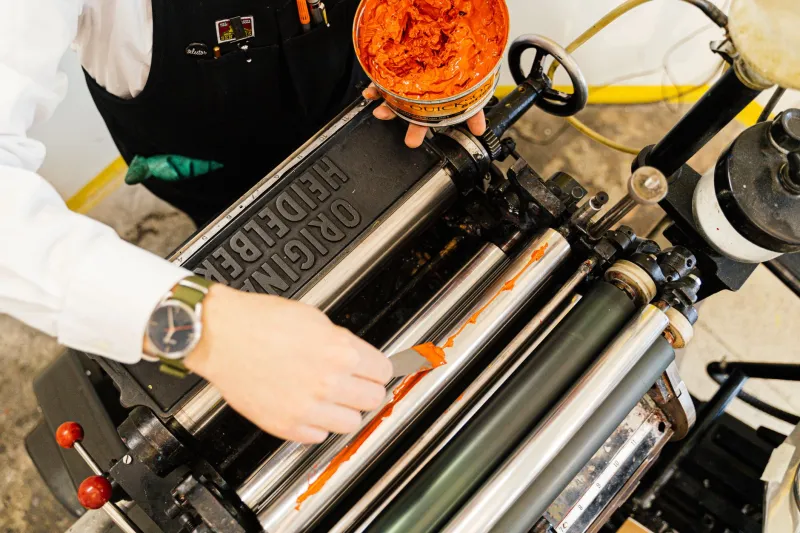
Then there's the rest of it. Ink. Paper—and not just any paper, because letterpress requires thick, cotton-rag stock that has some give to it. Type, whether antique lead or modern photopolymer plates made from digital files. A base unit to hold those plates. Rollers that need replacing. A light table. A magnifier. A decent amount of floor space and a willingness to occasionally be covered in ink from the elbow down.
"People see the finished card and they think it's quaint," says one letterpress printer who runs a small studio out of her Portland garage and asked to be identified only by her Instagram handle. "They don't see the three hours I spent getting the impression even, or the paper I ruined figuring out the ink viscosity. It's not quaint. It's engineering."
Why Social Media Made This Weird and Also Perfect
Here's the irony that everyone in this community acknowledges with a kind of amused resignation: letterpress printing's modern renaissance is almost entirely powered by digital platforms. Instagram, in particular, has been rocket fuel.
The aesthetic translates beautifully to photographs. That debossed impression catches light in a way that makes even a simple business card look like a museum artifact. Accounts dedicated to letterpress work rack up followers easily—there's something almost ASMR-adjacent about watching ink roll across type, or seeing a clean impression pulled from a press. The hashtag #letterpress has millions of posts. TikTok has its own thriving corner of press operators showing their setups, their process, their disasters.
This visibility has created a genuine market. Wedding stationery printed on a letterpress now commands serious premiums—couples routinely spend $800 to $2,000 or more on invitations alone, specifically because of the handmade quality. Greeting cards from small letterpress studios sell for $8, $10, $12 each, and people buy them without blinking because they feel like objects worth keeping. Posters, art prints, broadsides—there's a collector market for all of it.
For some operators, it's a side hustle. For others, it's become a full business. Either way, the economics are tight. The machines pay for themselves slowly, if at all. Most people doing this are doing it because they love it first, and the revenue is a welcome bonus.
The Community That Keeps It Alive
What's genuinely surprising about letterpress culture is how collaborative it is. You might expect a community organized around expensive, scarce equipment to be territorial. Instead, it skews remarkably generous. Experienced printers mentor newcomers. Equipment gets shared. When someone scores a haul of vintage wood type from a defunct newspaper, they'll often sell or trade pieces to other enthusiasts rather than hoarding everything.
Workshops and open studios have proliferated in cities across the country. Places like the Arm in Brooklyn, Hatch Show Print in Nashville, and dozens of smaller community print shops offer classes, equipment access, and a physical space for people who don't have room (or budget) for their own press. These places have become something like social clubs for a certain kind of creative person—the ones who want to make something they can hold in their hands at the end of the day.
There are also regional and national gatherings, letterpress-specific conferences, and an entire ecosystem of small suppliers who have built businesses around keeping these machines running. It's a full culture, complete with its own inside jokes, debates about which press is superior, and strong opinions about paper.
So What's Actually Going On Here?
At its core, the letterpress revival is a story about what happens when people get oversaturated with frictionless, invisible technology. Printing a document from a laptop takes three seconds and produces something you'll probably never look at again. Setting type, mixing ink, adjusting impression, and pulling a print from a 100-year-old press takes hours—and produces something you might actually frame.
There's a word that comes up constantly in this community: intentional. Every decision in letterpress printing is deliberate. You can't accidentally make something. The machine demands your full attention, and in return, it gives you an object with a physical history embedded in it.
Is it a little absurd? Sure. Spending $4,000 on equipment to make greeting cards that could be printed digitally for pennies is objectively not rational. But rationality was never really the point. The point is the ink smell, the mechanical clunk of the press cycling, the moment you peel back the paper and see a clean impression staring back at you.
Some rabbit holes are worth falling into. This one just happens to weigh 400 pounds.