Ink on Your Hands, Peace in Your Head: The Basement Letterpress Revolution Nobody Saw Coming
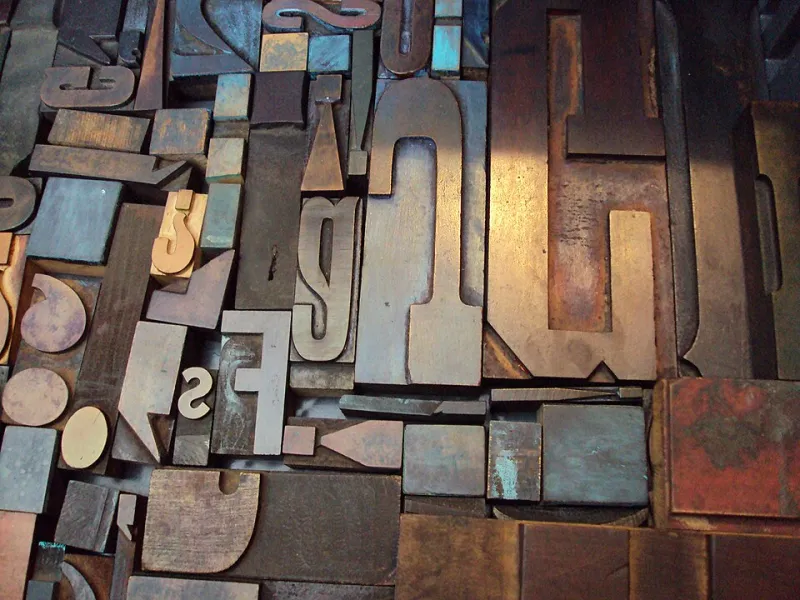
Photo: Michellecornelison, CC BY-SA 4.0, via Wikimedia Commons
There is a specific sound that Marcus Webb, 34, describes as "the most satisfying noise in the world." It's not a notification ping. It's not a playlist drop. It's the heavy, mechanical thunk of a Chandler & Price platen press completing a full cycle — the rollers kissing the type, the impression biting into paper, the whole machine exhaling like something alive. Marcus makes that sound happen about 400 times on a good Saturday, down in his Baltimore basement, surrounded by wooden type cases and the smell of oil-based ink that never quite washes out of your skin.
He is not alone in this. Not even close.
Across the country, in basements, garages, rented studio corners, and spare bedrooms, a loose and growing community of letterpress devotees has quietly assembled a movement that nobody really planned. They're hauling antique machinery out of defunct print shops. They're learning lead typesetting from YouTube tutorials and 80-year-old mentors. They're gathering on weekends not to network or optimize anything, but to pull prints by hand and argue about which paper stock takes ink the best.
In an age when you can design something on your phone and have it printed in China and shipped to your door in four days, these people have chosen the longest, most inconvenient possible route. And they will explain, at length, why that's the entire point.
How Does a 19th-Century Machine End Up in a Millennial's Basement?
The short answer is Craigslist, estate sales, and a stubborn refusal to let beautiful things die.
Letterpress printing — the process of pressing inked type directly into paper — was the dominant printing technology for roughly 500 years before offset lithography made it commercially obsolete in the mid-20th century. By the 1970s, most commercial print shops were scrapping their old equipment or letting it rust. A lot of those machines survived in church basements, school print labs, and the garages of stubborn old-timers who just couldn't let go.
Then a funny thing happened. Wedding stationery got trendy. Craft culture exploded. And suddenly people started noticing that the slightly uneven, deeply impressed quality of old letterpress printing had a texture and warmth that no laser printer on earth could replicate.
Small letterpress studios started popping up in Brooklyn and Portland and Austin. Then people started buying machines for themselves. A functional tabletop press can run anywhere from a few hundred dollars to a few thousand. A full-size floor press — the kind that requires reinforced flooring and a dolly and possibly a small crane — can cost tens of thousands, though most devotees find them for far less through the right channels.
Marcus got his 1920s Chandler & Price for $800 from a retiring printer in rural Pennsylvania. It took three guys, a rented truck, and one very stressful afternoon to get it down the basement stairs. "My wife was very patient," he says, with the tone of someone who knows he owes someone a significant favor.
The Resistance Is the Whole Thing
Ask anyone in the letterpress community why they do this and you'll hear some version of the same answer: the machine pushes back, and that's the point.
Digital tools are frictionless by design. You move a slider, the thing changes. You hit undo, the mistake disappears. Letterpress gives you none of that. You set your type by hand, one character at a time. You mix your ink by eye. You run a test print, see that the impression is off, make a tiny adjustment, run another test. The machine has opinions. It communicates through imperfection.
"There's no ctrl-Z," says Dani Okafor, 28, who runs a small print collective out of a shared studio space in Detroit. "If you mess up a print run, that's it. Those sheets are done. You have to actually pay attention the whole time, and I think my brain was starving for that."
Dani started printing during the pandemic, initially just to have something tactile to do. She's since built a community of about a dozen regular participants who show up on Saturday mornings to work on personal projects — cards, broadsides, zines, art prints — and to collectively troubleshoot the particular madness of keeping vintage machinery operational.
That social dimension comes up again and again. Letterpress shops, it turns out, are surprisingly good places to make friends.
Print Shops as Gathering Spaces
There's something about the shared frustration of analog craft that dissolves social awkwardness faster than almost anything else. When you're both covered in ink and trying to figure out why the impression is heavier on the left side, small talk becomes unnecessary. You're just two people solving a problem together.
Rachel Thorn, 41, runs what she calls an "open shop" out of her garage in Asheville, North Carolina. Once a month, she opens the space to anyone who wants to come learn on her two tabletop presses. She charges a small materials fee, teaches the basics, and then mostly gets out of the way. "People come in nervous and leave with ink on their faces and big grins," she says. "Something happens in here that I can't fully explain."
What happens, she thinks, is that people get to experience competence at something genuinely difficult. Not the simulated competence of a video game or the curated competence of a social media post — actual, physical, you-did-this competence. A thing exists in the world now that didn't before, and your hands made it.
The Imperfection Problem (That Isn't Actually a Problem)
Letterpress printing is not precise. The ink spreads slightly differently on every pull. The impression varies by a hair's breadth from print to print. Type that's been set by hand has the subtle irregularity of human judgment built into every line.
For people raised on pixel-perfect digital output, this is either deeply unsettling or deeply beautiful. The letterpress community has clearly landed on the latter.
"I used to chase perfection," says Marcus. "I'd run 50 test prints trying to get everything exactly right. Now I've learned that the variation is part of the work. Each print is actually slightly different. That's not a bug."
This tolerance for — celebration of — imperfection feels like something more than an aesthetic preference. It feels like a philosophical position. In a world that promises infinite refinement and infinite undo, choosing a process that can't be undone is a small act of commitment. You are here. This is happening. Pay attention.
The letterpress underground isn't trying to bring back the past. It's not a nostalgia trip or a Luddite protest. It's something stranger and more interesting than that: a community of people who looked at the infinite frictionlessness of modern life and decided, deliberately, to add some friction back in.
The machine is loud. The ink stains. The learning curve is real. And every Saturday in basements across America, the presses are running.