Ferris Wheels Don't Belong in Backyards. These People Didn't Get the Memo.
Let's say you're driving through a small town in Indiana on a Sunday afternoon and you notice something through the tree line. Something spinning. Something bright red and slightly too large to make sense next to a ranch house. You slow down. You squint. And then you see it — a fully operational vintage carousel horse, mounted on a custom platform, rotating gently in a guy named Dennis's side yard.
Dennis is not unusual. Not in this world, anyway.
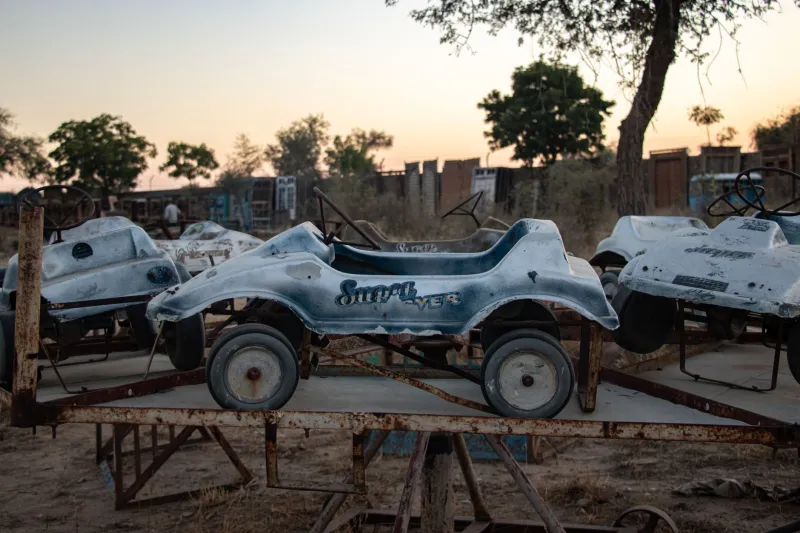
There is a quietly thriving subculture of Americans — mostly in the Midwest and South, though they exist everywhere — who have made it their life's mission to rescue the mechanical relics of the American carnival from the scrapheap. We're talking Tilt-A-Whirls, funhouse mirrors, vintage ring toss booths, hand-painted midway game facades, and yes, the occasional small-scale Ferris wheel. These are not decorative pieces. These people restore them. And in many cases, they actually run them.
How Does Someone Even Start Doing This?
The entry point is almost always the same: a childhood memory that got lodged somewhere deep and never quite let go. The smell of machine grease and cotton candy. The particular clang of a carnival bell. The way a midway looks at dusk when all the lights come on at once.
For Marcy T., a 44-year-old electrician from outside Knoxville, it started with a funhouse mirror she spotted at an estate sale in 2019. "It was just leaning against a barn wall, all cloudy and warped at the edges," she says. "I paid forty bucks for it. Brought it home, cleaned it up, hung it in my garage. And then I thought — what else is out there?"
What followed was a years-long deep dive into a surprisingly active auction ecosystem. Defunct amusement parks, when they close, don't just disappear — their contents get liquidated. Companies like Amusement Park Auctions and various regional estate sale operations regularly move inventory from closed parks, traveling carnivals that folded, and county fairs that upgraded their equipment. If you know where to look, you can find almost anything.
And once you find it, the real work begins.
The Restoration Rabbit Hole
Restoring a vintage carnival ride is not a weekend project. Ask anyone in this community and they'll laugh at you for suggesting otherwise.
Take Greg H., a 58-year-old retired machinist from central Michigan who spent three years and somewhere north of $40,000 restoring a 1970s Scrambler he bought from a closed park in Pennsylvania. The ride arrived in pieces — literally in pieces — loaded onto two flatbed trailers. "The hydraulics were shot, half the electrical was rotted out, and someone had painted over the original pinstriping with house paint," he says. "I cried a little."
But he got to work. He sourced period-correct parts through a network of fellow enthusiasts on private Facebook groups and a handful of specialty forums that look like they haven't been redesigned since 2004 (they haven't). He taught himself hydraulic systems from YouTube tutorials and old technical manuals. He found a sign painter in Wisconsin who could replicate the original lettering.
Three years later, the Scrambler runs. It sits on a concrete pad behind his shop building. He fires it up at family gatherings and for his grandkids. "Worth every penny," he says, with the conviction of someone who has absolutely done the math and is choosing not to share it.
What This Actually Costs
Let's talk numbers, because they are genuinely wild.
Entry-level pieces — a vintage midway game booth, a carnival sign, a single bumper car — can run anywhere from a few hundred to a few thousand dollars at auction, plus shipping, which is its own nightmare. Midsize mechanical rides like a vintage Round-Up or a Trabant can sell for $10,000 to $30,000 in non-working condition. By the time you've hauled it, assessed the damage, sourced parts, and done the labor (assuming you're doing most of it yourself), you're often looking at double or triple the purchase price to get it operational.
A full carousel restoration? Budget $80,000 to $150,000 and several years of your life. Some of the most dedicated collectors in this space have crossed the $200,000 mark across their combined acquisitions.
And yet — they keep going. Because the alternative, apparently, is just having a normal backyard.
The Community That Makes It Possible
What's kept this hobby alive is the same thing that keeps most niche obsessions alive in 2024: the internet connecting people who would otherwise be completely alone in their weirdness.
Private Facebook groups, Discord servers, and forums with names like "Carnival Warehouse" and "Amusement Underground" serve as the connective tissue. Members share parts leads, restoration tips, electrical schematics for rides that no longer have manufacturer support, and — critically — emotional support when a project hits a wall.
"I was ready to scrap the whole gondola section of my Ferris wheel in 2022," says Dave K., a hobbyist from rural Georgia who has been building what he calls a "personal midway" on his five-acre property for the past seven years. "I posted about it in the group at midnight on a Tuesday. By morning I had eleven responses, two parts leads, and a guy in Ohio who had the exact bracket I needed just sitting in his garage."
Dave's property now includes a working vintage Ferris wheel (small-scale, about 20 feet tall), two restored bumper cars on a custom track, a fully operational ring toss booth, and what he describes as "the beginnings" of a haunted house walkthrough built inside a repurposed barn. His neighbors, he says, have mixed feelings. His kids have no mixed feelings whatsoever.
Is This Nostalgia or Something Else?
It would be easy to write all of this off as pure nostalgia — grown adults spending absurd amounts of money to recreate the feeling of being eight years old at the county fair. And sure, that's part of it.
But spend any time talking to these collectors and a different picture emerges. There's a preservation element that feels genuinely meaningful. Vintage carnival rides are disappearing fast — scrapped for metal, left to rot in fields, or simply lost when parks close and nobody cares enough to document what was there. The people doing this work are, in their own chaotic way, keeping a very specific slice of American vernacular culture alive.
The hand-painted midway signs. The particular engineering of a 1960s ride mechanism. The folk art quality of a carnival funhouse facade. These things exist nowhere else, and when they're gone, they're gone.
"Museums aren't going to save this stuff," Marcy says. She's up to six funhouse mirrors now, plus a vintage skee-ball lane she's currently rewiring. "So I guess we are."
Somewhere in Indiana, Dennis's carousel horse keeps spinning. His neighbors have mostly come around. One of them, last summer, asked if she could bring her grandkids over.
She could.